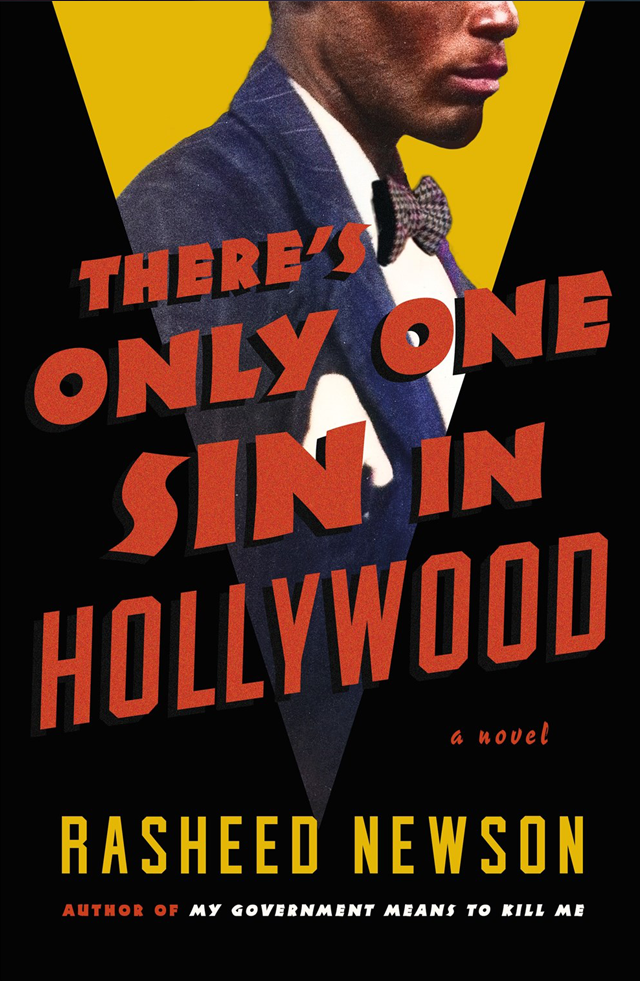
Rasheed Newson’s sophomore novel, There’s Only One Sin in Hollywood, takes the reader on a first-class journey back to the so-called golden age of Hollywood. The first gripping pages envelop the reader in a way reminiscent of the lowering of cinema lights as the story reels out across the page.
The main character, Aaron Toussaint, is enamored with the silver screen from the tender age of seven, going from exuberant audience member to projectionist assistant, to “Hollywood fixer.” It is in this role of secret keeper and scandal neutralizer, that he must inevitably confront his childhood belief that he “could save the stars.”
Newson leads readers through Aaron’s story of escaping his violently homophobic family, finding love in the Air Force as a Black gay man, and carving a space for himself in Hollywood, with an attention to historical detail and insider knowledge that would make any cinephile or historian giddy. Weaving real people, places, and events into this fictional account gives the novel a feeling uncannily close to that of a tell-all memoir. What truly sets Newson apart in the historical fiction genre is how much care and research he puts into making his writing as true to the past as possible while inserting his fictional characters seamlessly. Newson excels at writing characters that are nuanced, flawed, and deeply human. The characters in There’s Only One Sin in Hollywood are far from perfect; they make mistakes, hurt others, and are deceitful. Precisely because of that realness, so tangible that you can sink your teeth into it, readers will find themselves rooting for the characters to the very end.
One of the themes Newson invites readers to explore alongside Aaron is that of “borrowed memories.” In Aaron’s case he loans out memories of the man he loved to the other focal character Xavier. This comes at a cost that snowballs out of his control yet is the only way he knows to preserve what was real and beautiful to him in a world that condemned him for not only his skin tone, but who he loved. This exploration of borrowing memories prompts the reader to ponder the importance of what we can learn from memories of the past, and how we must be brave enough to preserve them for the future.
In conjuring the magic of a great movie capable of making one believe anything is possible for our heroes, There’s Only One Sin in Hollywood will similarly imbue readers with hope on every page that the main characters can best the forces working against them. Readers will watch Aaron torn between institution and authenticity, and as the stakes mount and the consequences compound, Aaron must answer a question that I invite readers to consider themselves: If there is only one sin in Hollywood, but that sin promises freedom, is it worth the risk of damnation?