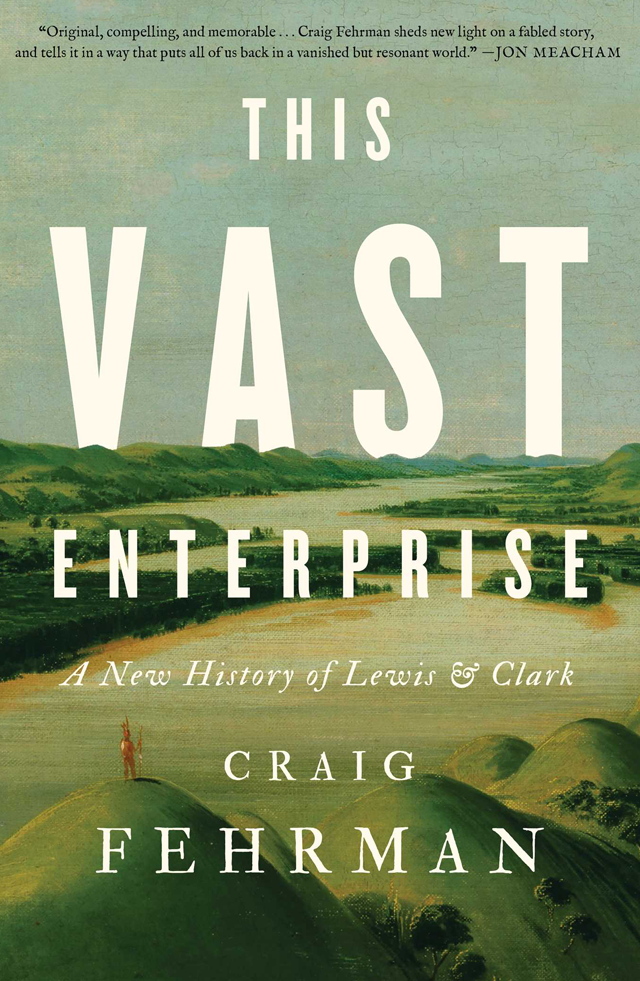
Though their names are synonymous with its journey, the Corps of Discovery’s story is about much more than Lewis and Clark.
In This Vast Enterprise Craig Fehrman fleshes out the cast of characters who inhabit this sweeping scientific, diplomatic, and military adventure, complicating and enriching our understanding of the expedition that President Thomas Jefferson hoped would map a direct water route across the continent and expand the new nation’s boundaries.
Through painstaking research and the use of oral histories, each chapter is told from the perspective of a different person who shaped the journey, not just the famous names in the title. In fact, the first characters introduced are not Lewis and Clark but competing Lakota leaders with vastly different ideas of how to steward their people through changing times.
Fehrman makes Meriwether Lewis, whose scientific achievements can seem almost superhuman, real and relatable by examining his anxiety and “hypochondriac affections,” a melancholic tendency the reader may recognize as depression (though Fehrman sensitively refrains from diagnosing).
Before we meet the other titular character, we meet York, one of the Corps’ hardest-working members and Clark’s enslaved body servant. Though York did not choose this dangerous mission, Fehrman shows him asserting his independence, earning the respect of the corps, and even casting his vote in key decisions (like where to establish a winter camp).
While Fehrman introduces William Clark after York, the author resists defining Clark by his moral failings. The author acknowledges that society shaped Clark’s ideas of right and wrong, including his acceptance of slavery, while noting that calling someone “a man of his era” is “a phrase that often deflects as much as it describes.” But Fehrman also shows Clark as the more respectful of the two captains toward Indigenous peoples and their knowledge.
As the nation celebrates 250 years of the Declaration of Independence and reexamines our founding ideals, Fehrman’s account of Lewis and Clark’s experiments with democratic military structure feels especially timely. The captains were lenient with their men, prioritizing cohesion over strict discipline. When a court martial became necessary, they turned judgment over to the offending soldier’s peers. When the Missouri split unexpectedly into two branches, Lewis and Clark put the decision to a vote, ensuring collective commitment to whatever difficulties lay ahead.
The chapters told from Sacajawea’s perspective are especially compelling. Fehrman makes clear that while her translation, navigation, and diplomatic work were essential to the Corps’ success, she had her own motivations for crossing the continent with her newborn. Having been taken from her Shoshone home by Hidatsa raiders and sold to the trader Charbonneau, the Missouri River was for Sacajawea “the river leading home.” Her journey was not one of discovery but of recovery and return to her people.
Where a dearth of sources makes Indigenous perspectives hardest to reconstruct, Fehrman is at his most careful with his interpretation. For example, he includes an appendix of conflicting primary source accounts of a clash between the Corps and Blackfoot warriors, inviting readers into a direct conversation about where sources disagree.
Fehrman also creates a main character of the verdant landscape, rich with natural beauty and resources, and fully populated by sovereign peoples. Fehrman paints this landscape, and the characters travelling through or inhabiting it along with reprinted documents, maps, and artwork.
Read This Vast Enterprise if you are interested in not just Lewis and Clark, but the full story of the expedition they led, one full of scientific, social, and political history, action, adventure, heartbreak, and redemption.