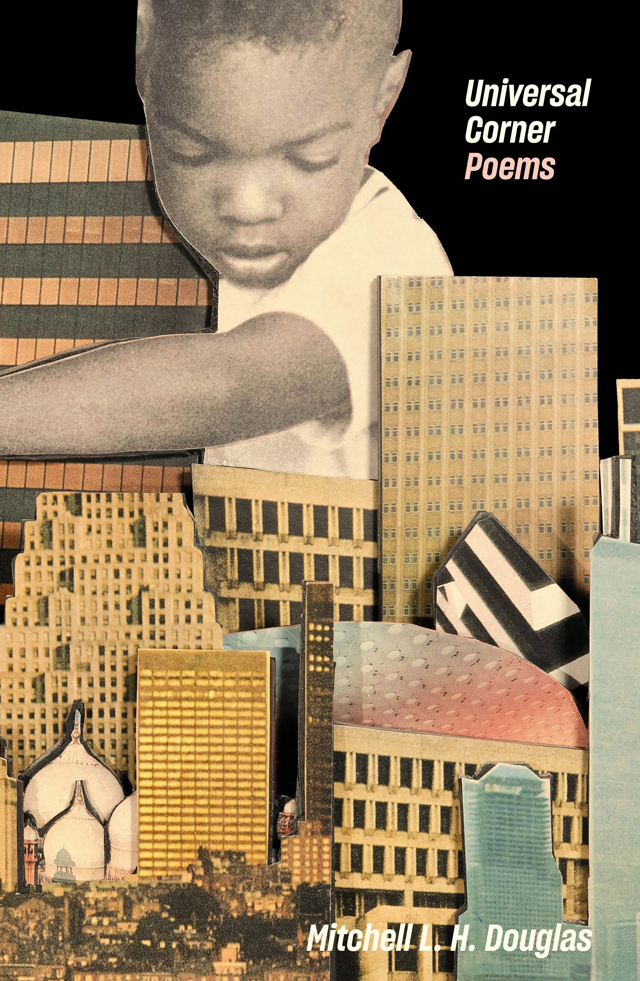
In Universal Corner, Mitchell Douglas complicates the familiar monolithic narrative of Black coming-of-age by testifying at the altar of punk music and of a present Black father with a PhD. The speaker here isn’t Doughboy, but he knows Doughboy. The speaker was listening to the punk band X while Doughboy was turning tight ones on Crenshaw Boulevard. Iowa City is a long way from LA, from NYC, from London, but still somehow exactly where a Black punk rocker and graffiti artist could come of age. While reading this gem of a collection, I found myself remembering Walt Whitman’s boast, “I am large, I contain multitudes.” The speaker of Douglas’s poems evinces Whitman’s wisdom, but this lands even more gracefully when we are reminded that the truth of Whitman’s words applies to Black folks, too, especially Generation X, Black males whose stories have been told to us innumerable times through heartwrenching hood-tales of Bildungsroman, taking place on crack-laden streets, loud with gunfire and police sirens. None of that here. Or rather, it’s here, but not centered. It haunts, stalks, lurks in all American experience, but here it never becomes the center. How refreshing to read a Black coming-of-age book that exudes middle-class ache and rebellion colored by gravity of race but not sunk by it.
Perhaps my favorite moment in the text is Douglas’s ode and eulogy to his father, “black classical,” read at his father’s funeral, according to the book’s notes. From the epigraph by Mari Evans (the focus of Douglas’s father’s dissertation and book) to the poem’s bookended anecdote of the speaker’s father telling him to “Get up,” this poem disrupted caricatures of Black men, of Black fathers, by showing a dad who is present. I could stop there. That alone would be enough. But not only is the father present; he’s caring, erudite, a mentor, willing to compromise, willing to listen. No yelling here. No whoopings here. Instead, the speaker’s father is an accomplice. Douglas writes,
Remember:
You are 10 & the Black player
on your baseball team (& he knows
what that means,
so he becomes the only Black coach).
I love the image of father and son fighting white supremacy together, two Black bodies standing in the eye of a blizzard together, staying warm from each other’s fire, together playing America’s game. How beautiful is that? How enchanting. And for a quick bit, let’s talk about the craft Douglas exhibits here: the isolated lines cascading down the page, slow and deliberate like late Coltrane; the internal velocity granted by the ampersands; the nasty double-edged suspension of the line break on “knows,” where Douglas gets two meanings for one. Douglas commits fully here. He’s bearing witness to Black love while displaying Black excellence in craft. He’s paying homage to the ancestors while fulfilling their prophecies. He’s making me want to go kiss my son. Universal Corner is a book about Black boyhood and fatherhood, but it is also about art, music, geography, inheritance, and the powerful permission to be more than the stories already written for you.