

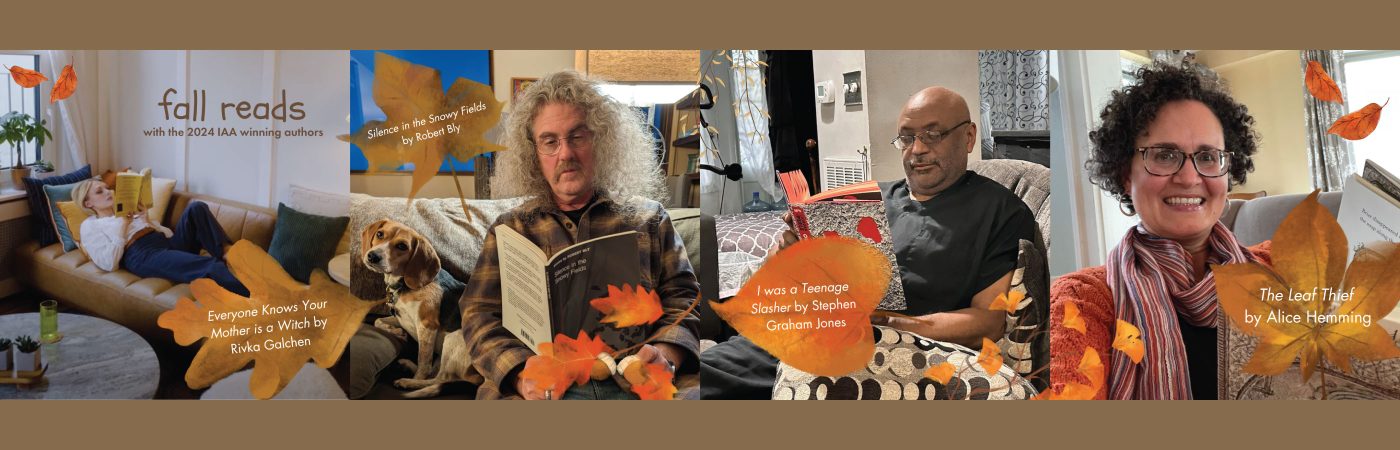
Indiana Authors Awards winners share their fall book recommendations
IAA News
Indiana Authors Awards winners share their fall book recommendations
As temperatures and leaves start to fall, there’s no better time to crack open a new read. Enjoy these fall reading recommendations straight from some of this year’s Indiana Authors Award winners.
Tess Gunty, author of the 2024 Indiana Authors Awards fiction-winning book The Rabbit Hutch, recommended Lanny by Max Porter. Here’s what she had to say about the fiction novel: “a village on the outskirts of London, a lurking folkloric creature, an imaginative little boy, an atmospheric disturbance. It’s also a brilliant audiobook; they essentially made this formally experimental text into a glorious radio play. I could eat the language of this book for breakfast, lunch, and dinner.”
For historical fiction fans, Gunty also recommended Everyone Knows Your Mother is a Witch by Rivka Galchen, which she described as “a fictional but rigorously researched account of a real woman accused of witchcraft in 17th-century Germany.”
Maurice Broaddus, whose book Unfadeable won the 2024 Indiana Authors Awards Middle Grade category, turns to spooky, crime-centric novels during this time of year. Broaddus’ usual favorite fall authors are Victor LaValle and Tananarive Due. In describing them, he shared: “These two are masters of horror and suspense; their writing with an eye toward social commentary along the way which is why I love them so much.”
For readers looking for a spooky read, Broaddus said he just started I was a Teenage Slasher, by Stephen Graham Jones.
“His last book, The Only Good Indians had me shook the entire time, so I can’t wait to delve into this one,” Broaddus said.
In addition to recommending Indiana author Franklin Bill’s Crimes in Southern Indiana, Broaddus also shouted out S.A. Cosby’s Blacktop Wasteland.
2024 winner of the Poetry category author George Kalamaras had three book recommendations to cozy up with this autumn. Kalamaras recommended Robert Bly’s Silence in the Snowy Fields, saying: “This remarkable book of poetry focuses on solitude and silence, with several poems set in fall and winter. I make a habit of trying to re-read this 1962 collection nearly every autumn.”
Kalamaras also noted Days at the Morisaki Bookshop, by Satoshi Yagisawa (translated by Eric Ozawa). Kalamaras said while he only recently discovered the read, reading it and its sequel, More Days at the Morisaka Bookshop, often remind him of autumn.
Here’s what he had to say about the two books: “Who does not long to curl up with a good book after browsing a unique used bookstore? These books focus on being in the bookshop, even living in an upstairs part of it, surrounded by stacks of books, for a short while. It’s a cozy autumn read that brings us back to the roots of why we love hunting for and reading the books that we do.”
Janna Matthies, author of the 2024 Indiana Authors Award winning children’s book Here We Come!, recommended three family-friendly reads perfect to enjoy this fall.
Matthies first recommended The Leaf Thief, written by Alice Hemming and illustrated by Nicola Slater, calling it “the perfect explicitly-fall read for those looking for a cuddly laugh together, plus food for thought on how and why the leaves fall in autumn.”
Matthies also recommended Evergreen, written and illustrated by Matthew Cordell, which features a nervous young squirrel, Evergreen, who must do hard things in order to help her ailing Granny Oak. Matthies said this about the book’s plot and illustrations: “Cordell illustrates the book in his signature scratchy style washed over with warm autumn tones. Soup is at the center of the story (Who doesn’t think SOUP in fall?). And the soup’s tureen is a fallen acorn. So many seasonal scenes and warm feelings in this six-part, classic-style children’s story.”
For an “atmospherically autumn book,” Matthies recommends Margaret’s Unicorn, written and illustrated by Briony May Smith, which is about a little girl whose family relocates to countryside reminiscent of the Scottish lowlands. where Matthies first encountered the book. Matthies said the book perfectly paces the transition of the seasons, from fall all the way through spring.