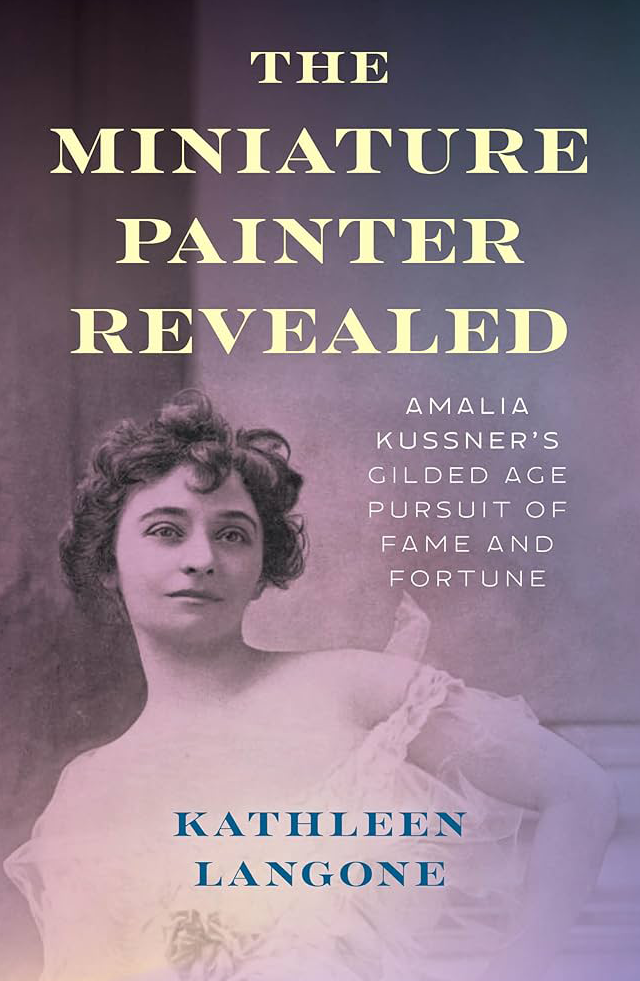
Amalia Kussner, though petite in stature, clearly possesses an outsized sense of herself, which becomes evident as we read about her relentless pursuit of fame and fortune. Her pathway to insinuating herself into the social lives of the rich and famous of the Gilded Age was to paint flattering tiny portraits of them on oval ivory keepsakes. At her career’s zenith, from the 1890s to early 1910, owning one of Kussner’s miniatures was “just as important an accessory as owning fine jewelry or a mansion in Newport,” according to Lyons Press.
The story of Kussner’s carefully curated self-image and obsessive accumulation of publicity does little to endear her, but one must admire her chutzpah for ingratiating herself to European royalty and affluent Americans. If you’re interested in Who’s Who at the turn of the last century, this book is for you. Her list of miniature portraits includes the Prince of Wales (later Edward VII), Czar Nicholas II of Russia, Lillian Russell, and Crawford Fairbanks, to name a few.
Flouncing her way into high society wearing tailor-made gowns and suede gloves, Amalia Kussner’s main interest is her impeccable sense of fashion. Not to imply that she didn’t work hard. The concentration and precision required, using brushes of only three to six bristles and a magnifying glass, illustrate miniature portraiture’s overlap between decorative and fine art.
The author’s fascination with Kussner was sparked by her distant kinship. Although choosing a biographical subject and then researching a life can be daunting, Kathleen Langone does a commendable job of digging up related newspaper articles and archival collections, which she augments with an impressive bibliography of background reading.
Billed as a revelation of Kussner’s scandals, the book describes missing distributions in her husband’s family, and a lawsuit filed against the artist for an alleged indiscretion that was never publicly revealed. For a woman who “had gone to great effort to spin a mythology about her age and artistic training for years,” the negative press would have been distressing, though these indignities pale in today’s context.
The author credits Kussner with revitalizing miniatures long after they had outlived their initial popularity due to the invention of photography in the mid-1800s. This revival, particularly in the United States, spawned the American Society of Miniature Painters in 1899. Kussner, however, did not appear to be interested in exhibiting with or learning from fellow artists.
Why does an artist create artwork? Some are driven by the urge to express themselves; others wish to make a social statement; and many find joy in the creative process. For Kussner, art was a means to an end. She unabashedly used it to gain entrance into the most exclusive parlors in the world. Her success was astonishing.
I would have enjoyed more context of the artist’s early life in Indiana and was disappointed that Kussner’s more famous contemporaneous woman artist from Terre Haute, Ada Walter Shulz (1870-1928), was not mentioned. However, this is not a book about art but a book about an entrepreneur.