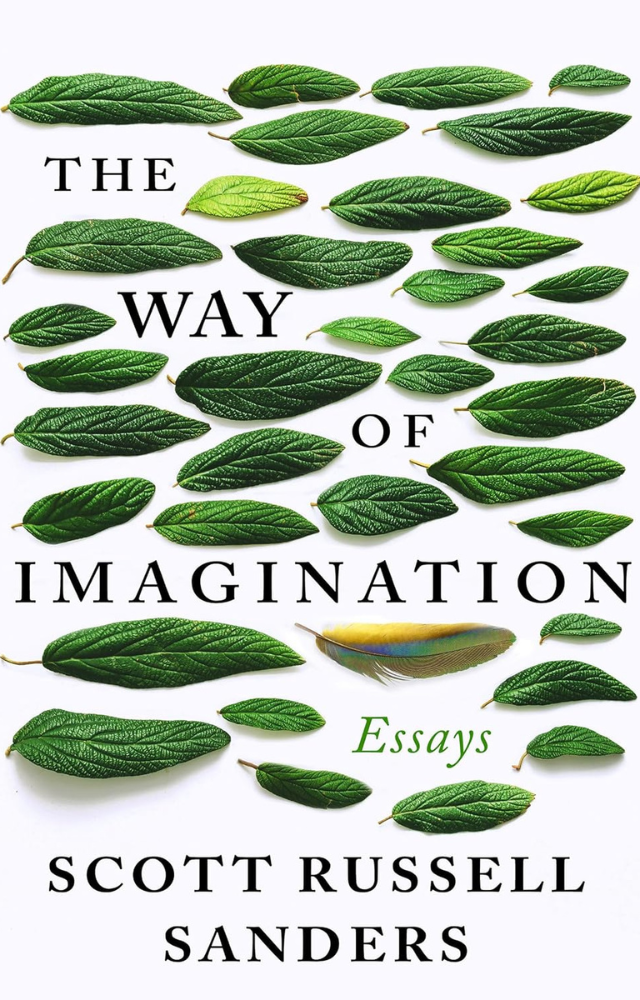
<i>The Way of Imagination</i>

The Way of Imagination

Book Reviews

2020 shortlisted poet Kevin McKelvey reviewed Scott Russell Sanders’ book The Way of Imagination.

Monthly reviews of books written by Indiana authors are made possible by the Eugene and Marilyn Glick Indiana Authors Awards and Indiana Humanities. Opinions expressed in this review are solely those of the reviewer, not any affiliated entity.

Scott Russell Sanders has always provided us with a way to look at the Ohio Valley, at Indiana and beyond, to make sense of what is around us, and that continues in The Way of Imagination, published this year by Counterpoint Press.  

Sanders is looking back at a full life lived in Bloomington, more personal than many of his previous essays. His criticism of the present has never been sharper, and it’s tempered by looking forward to the future where, he argues, the human imagination will be paramount.   

Beauty and grief are central in these essays, and they open new ways to explore some of his chief concerns on climate change and environmental loss and the future of humanity. Another common theme in these essays is his spirituality, rooted in but untethered from church or the Bible or God and made profound by science and the natural world and wonder. His essays have always ranged widely between ideas and inspirations, moving from personal narrative to science to a Bible quote to a literary reference and back again. These moves are effortless in The Way of Imagination, free of friction to generate energy and connection.  

One of my favorite Sanders forms is a roving analysis and exploration (and self-exploration) of literature, an application of his early PhD work in literary criticism. In different essays in The Way of Imagination, he focuses on Thoreau’s Walden and on Thomas Merton. In “Writing While the World Burns,” he considers contemporary environmental writing, his peers like Gary Snyder and Mary Oliver and Wallace Stegner and Barbara Kingsolver, and his own early influences. Needless to say, Sanders is an indispensable environmental writer.  

The Way of Imagination’s closest companion might be Writing from the Center, a book I teach in class or share with friends every chance I get. Together, they bookend twenty-five prolific years. In this book you’ll find connections to much of Sanders previous work, and it serves as a coda to Earth Works: Selected Essays, published in 2012.   

Read this book with a journal. Be ready with a bookmark so you can put the book down for an hour or two to pursue some idea or inspiration. These essays are forged in such a way to spark your imagination. 

Monthly Indiana book reviews delivered straight to your inbox

About Scott Russell Sanders

About Scott Russell Sanders

Born in Tennessee and reared in Ohio, Scott Russell Sanders studied at Brown University and earned his Ph.D. from the University of Cambridge before going on to become a Distinguished Professor of English at Indiana University.

From his home amid the oaks and owls of southern Indiana, he reflects on the vast, marvelous, ongoing show we call nature, and he puzzles about our two-legged species—wondering why we divide into hostile tribes, fight wars, and degrade the conditions for life on Earth—and he imagines how we might live more wisely.

He is the author of more than twenty books of fiction, essays, and personal narratives, including Hunting for Hope, A Conservationist Manifesto, A Private History of Awe, and Earth Works: Selected Essays. His latest books are The Way of Imagination, a reflection on healing and renewal in a time of social and environmental upheaval, and Small Marvels, a slightly magical novel-in-stories. In addition to works of fiction and essays set in the Hoosier state, he has written the text for Wild and Scenic Indiana, and he has written about our limestone heritage in Stone Country: Then & Now, co-authored with photographer Jeffry Wolin. For his writing, Sanders has won the Lannan Literary Award, the Associated Writing Programs Creative Nonfiction Award, the John Burroughs Essay Award, the Mark Twain Award, and the Eugene and Marilyn Glick Indiana Authors Award, as well as fellowships from the Guggenheim Foundation and the National Endowment for the Arts.

His work has appeared in such magazines as Harper’s, Audubon, Orion, and The Georgia Review, and it has been reprinted in The Art of the Essay, The Norton Reader, and more than a hundred other anthologies, including the annual Best American Essays. He was elected in 2012 to the American Academy of Arts and Sciences. His writing examines the human place in nature, the pursuit of social justice, and the search for a spiritual path. He and his wife, Ruth, a biochemist, have reared two children and helped rear two grandchildren in their hometown of Bloomington, in the hardwood hill country of Indiana’s White River Valley.

About Kevin McKelvey

About Kevin McKelvey

Kevin McKelvey is a place-based poet, writer, designer, and social practice artist. He teaches at University of Indianapolis and directs the M.A. in Social Practice Art and oversees the undergraduate major in Environmental Sustainability. At University of Indianapolis, he founded Etchings Press, a student-run publisher, helped start a community garden and microfarm, and has contributed to numerous interdisciplinary efforts for students and the community.

His poems have appeared widely in journals, books, and as pieces of public art. Dream Wilderness Poems is a poetic trail guide for the Deam Wilderness Area near Bloomington that represents years of exploration in the Hoosier National Forest that started with a summer job in college looking for invasive plants. The book was influenced by multiple hikes and camping trips, leading student hikes in the Deam, and numerous trips to local libraries and the Lilly Library at Indiana University.

Other poems are collected in Indiana Nocturnes, a collaboration with another native Hoosier, Curtis L. Crisler. The book explores the rural and urban divide in Indiana, focusing on local places like Lebanon and Marion and Gary, and our long history around race, class, and culture. McKelvey regularly creates poems to be viewed publicly, many times for Brick Street Poetry, covering a wide range of subjects such as beehive kiln brick factories, freshwater mussels, nature preserves, and other places.

With inspiration from his students and teaching, McKelvey has drafted a novel and numerous essays about the till plain region where he grew up in rural Boone County. His essays also capture his work in social practice art and creative placemaking, such as “Eight Gardens: On Gardening as Social Practice.” McKelvey has been a long-time collaborator on Big Car projects, and his social practice and placemaking continue to explore the intersections of art, writing, ecology, gardening, food, and farming.

Additional awards include multiple grants from the Indiana Arts Commission and a creative renewal fellowship from the Arts Council of Indianapolis. McKelvey currently serves on the board of Central Indiana Land Trust and regularly consults on grants, placemaking, professional writing, and creative writing. McKelvey attended DePauw University in Greencastle and completed his M.F.A. in poetry and creative writing at Southern Illinois University Carbondale.